
PCM vs Traditional Ice Packs: What’s the Difference?
5min read • Material Science
Why This Comparison Matters
At first glance, PCM packs and traditional ice packs both provide cooling.
The real difference is how they manage temperature.
For cold chain, medical shipping, and premium food delivery, this difference directly affects:
- Product safety
- Freeze protection
- Hold time
- Shipping reliability
Traditional Ice Packs: Simple Cooling
Traditional ice packs are designed for general cold retention.
Most freeze near 0°C, which makes them useful for:
- Lunch bags
- Short food delivery
- Local grocery transport
- Simple retail cooling
Their main advantage is low cost.
But because they cool around a fixed 0°C point, they may become too cold for sensitive products.
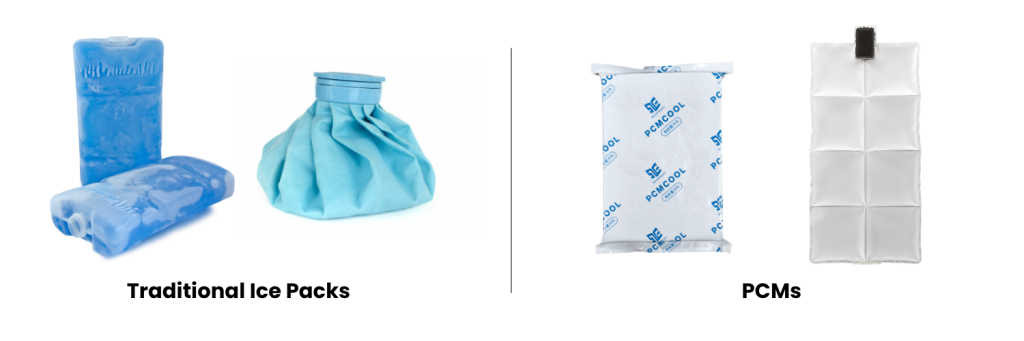
PCM: Temperature Control Instead of Basic Cooling
The biggest advantage of PCM is temperature precision.
Instead of only staying cold, PCM is selected to stabilize around the required product temperature, such as:
- 5°C for vaccines
- 18°C for insulin
- 22°C for temperature-sensitive cosmetics
- -20°C for frozen food
- This allows the shipment to stay closer to the safe range. Ice packs cool. PCM protects the required temperature window. That is the key difference.
*Example
A vaccine shipper for Southeast Asia may use:
– Inner layer: 5°C PCM for temperature hold
– Outer layer: 18°C PCM or insulation foam for heat buffering
This multi-layer strategy improves system robustness.
Which One Is Safer?
For temperature-sensitive products, freeze damage is often the main risk.
Traditional ice packs can freeze products near the box wall.
PCM is safer because the temperature is controlled closer to the product requirement.
This is especially important for:
- vaccines
- blood samples
- insulin
- -20°C for frozen food
- chocolates
- biologics
Which One Lasts Longer?
In short-duration delivery, both work well.
For longer shipping lanes, PCM is usually more efficient because it releases thermal energy exactly where temperature control is needed.
This often gives:
- better hold time
- less overcooling
- fewer packs required
- lower shipping weight
Which One Should You Choose?
Choose traditional ice packs when:
- cost is the priority
- shipment duration is short
- temperature precision is not critical
Choose PCM when:
- the payload value is high
- freeze protection matters
- the product has strict temperature limits
- shipping time is 24+ hours
- the payload value is high
Conclusion
The biggest difference between PCM and traditional ice packs is simple:
traditional ice packs provide cooling, while PCM provides controlled temperature protection
For general use, ice packs remain practical.
For cold chain and temperature-sensitive shipping, PCM offers better safety, stability, and performance.
Address List
- #707 Jia Qian Road Nanxiang, Jiading Shanghai, China
- +86 13301781710
- info@pcmcool.com
Social Networks
- Shawn Lee
- +86 1330178710
Links
Ru Entropy Technology Co., Ltd.
- © 2025 Ru Entropy Technology Co., Ltd.
- All Rights Reserved
- PCMCOOL® is a registered trademark of Ru Entropy